On the fourth day of Kissimmee, we have a community team looking to maintain last year’s strong showing, two regional champions looking to make national claims, a regional transplant fighting for pride for both its home and adopted region, and a college team with a historic pedigree making its long awaited return to the national stage.
Showing posts with label USA - Northwest. Show all posts
Showing posts with label USA - Northwest. Show all posts
Thursday, March 30, 2017

Wednesday, March 29, 2017
US Quidditch Cup 10 Preview: The Third Day of Kissimmee
On the third day of Kissimmee, we have a college team with dreams of its first national title, some isolated teams that were surprise qualifiers, and a regional champion who surprised many with a deep run last year and will be looking to repeat the feat.
Texas State University - San Marcos
By Carrie Soukup
Editor’s note: The author is the Volunteer Coordinator for the Texas State Quidditch Organization.
If Texas State comes to your tournament, there is a fair chance it will take home silverware, as five of its six tournaments this year have ended with a first- or second-place victory. Its only elimination this year came at Diamond Cup V at the hands of Texas Cavalry, while at Alamo Cup, Texas State went 5-0, victorious on its quest for a trophy at last. At the Southwest Regional Championship, Texas State again came in second place behind Lone Star Quidditch Club, after knocking off tournament favorites Texas Cavalry.
Rapid Reaction: US Quidditch Cup 10 Pools
By Andy Marmer, Austin Wallace, Christopher Dewing, Alex Russell, and Carrie Soukup
Editor’s Note: The following is a quick analysis. While the Quidditch Post’s editors did their best to ensure the accuracy of all stats and information, due to our desire to provide quick and timely information, some errors may have arisen. We apologize for any mistakes and will do our best to correct any incorrect information that is pointed out to us.
The Tuesday 11 days before a major tournament means one thing: pool draws. A favorable pool can be the springboard to Day Two glory, as it allows for easy wins, high point differentials, and a top seed entering the bracket. On the other hand, a difficult pool can be a death sentence that causes tough games, lower than-expected seeding, and of course the possibility of elimination. With USQ announcing the pool draw for US Quidditch Cup 10, we break down each pool, games, and fun facts on our way to identifying the 36 teams that will advance to bracket play.
Monday, March 20, 2017
Consolation Cup Provides Alternative to US Quidditch Cup
By Danielle Lehmann
For many teams who did not earn a bid for US Quidditch Cup 10, competing against out-of-region teams is no longer a possibility. Last year, however, Texas State Quidditch changed that prospect for many who just missed out on national-level play. Texas State returns with Consolation Cup II this weekend, when 22 teams (Editor’s Note: One team has dropped from Consolation Cup II, but as of press time the identity of this team has not been confirmed) make their way across the United States to compete in the intense tournament.
Friday, March 17, 2017
Rocky Mountain Fever: How the (North)west Was Won
By Cameron VomBaur
Editor’s Note: The author is a captain of Utah State Quidditch Club
For the most part, the USQ Northwest Regional Championship held very few surprises. Going in, the favorites to earn the region’s two bids to US Quidditch Cup 10 were the Boise State Abraxans and Utah State Quidditch Club (USQC). Of the remaining four teams, the Rain City Raptors and Provo Quidditch were expected to be the most likely to present the top two contenders with any sort of challenge. And while Western Washington Wyverns (WWU) and Emerald City Admirals had some impressive upsets on the season, their status as legitimate contenders existed another tier lower. The tournament’s final standings wouldn’t appear to clash with this narrative; however, there were a handful of very surprising results, chiefly involving Provo Quidditch.
Monday, March 13, 2017
QCON March Recap
By Misha Whittingham
March 4 saw the last round of games for the Quidditch Conference of the Northwest (QCON) leading up to the conference’s playoff weekend on March 18-19. The series saw continued parity between the majority of the conference, with no team other earning more than two wins without the aid of a forfeiture. Low numbers for both University of British Columbia Quidditch Club (UBCQC) and Simon Fraser University (SFU) additionally required QCON to allow the use of USQ gender rules, while still maintaining the rest of the Quidditch Canada (QC) rulebook.
Friday, March 3, 2017
2017 Northwest Regional Championship Preview
By Misha Whittingham, Cameron VomBaur, Austin Wallace
The final two bids at US Quidditch Cup 10 are on the line at the Northwest Regional Championship this weekend. With just six teams in attendance, the Quidditch Post breaks down who to watch in the round robin tournament.
Seven Players to Watch
1. Matt McCracken ― Boise State Abraxans
Without any tournaments outside of Boise or Utah on the season, Matt McCracken’s talent has been a relative secret to those who have seen him firsthand. While not technically a rookie, his 2015-16 experience was limited to a single week of practice before travelling to US Quidditch Cup 9, where he played a supplemental chasing role in Boise State’s surprise quarterfinal run. Relying solely on raw athleticism and general sports experience then, his game evolved exponentially during the fall semester. At his first tournament, Crimson Cup, he played almost exclusively as beater, employing an extremely physical style. However, by the Top of Utah Classic and Tree City Tournament (two and four weeks later, respectively), he was unleashed as a chaser and seeker. His dominating physicality was often the sole driver of Boise’s goals while he was on pitch, and his newly-displayed seeking skill yielded a 6-0 SWIM record after Crimson Cup.
Sunday, February 26, 2017
Dinos and Dragons: QCON February Recap
By Nathan Ross and Serena Cheong
While not every set of scheduled Quidditch Conference of the Northwest (QCON) matches were able to take place over the February 18 weekend, the ones that did had lots of upsets and makes for a dramatic finish before the upcoming QCON playoff weekend on March 18-19, 2017.
While not every set of scheduled Quidditch Conference of the Northwest (QCON) matches were able to take place over the February 18 weekend, the ones that did had lots of upsets and makes for a dramatic finish before the upcoming QCON playoff weekend on March 18-19, 2017.
Tuesday, February 21, 2017
USQ Northwest and UBC Adjust to Life Apart
By Jordan Kubichek
This past year, the University of British Columbia Thunderbirds Sports Club (UBC) of Vancouver, British Columbia has pulled up stakes from the Northwest region of USQ. This is due to a new ruling by USQ to remove the team from the region; there has been a recent push by the organization to include members only within the United States. The region has adapted to the change, but there have been ripples felt throughout the Northwest region in the wake of UBC’s removal.
Some players lament the loss of a friendly rivalry.
“UBC was one of the most competitive teams (it came in third last year at [the regional championship] and has played in two national [championships]),” said Megan Boice, president of the Western Washington University Wyverns (WWU). “Playing good teams makes all teams better.”
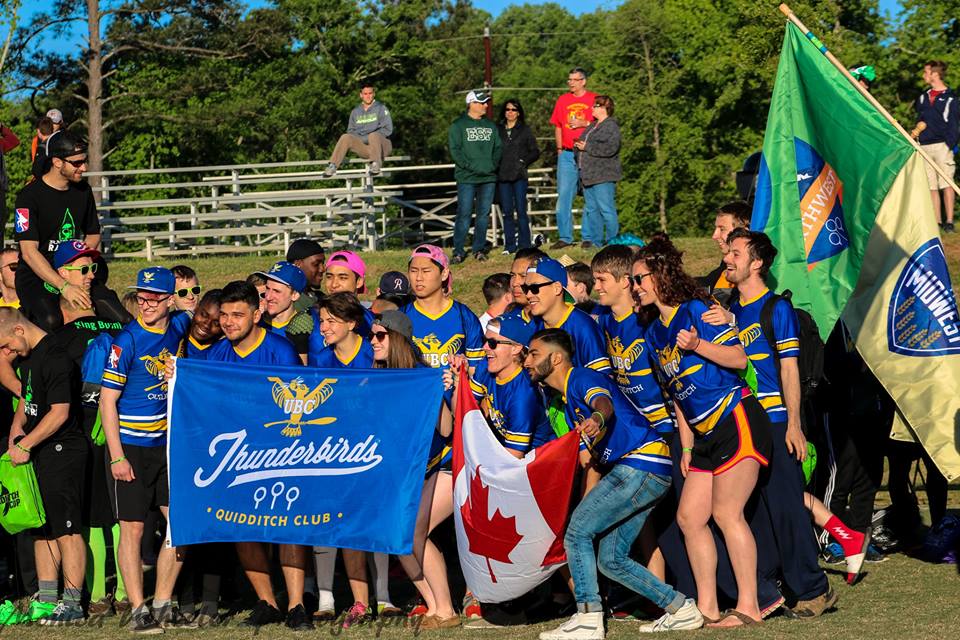 |
| The UBC Thunderbirds pose for a team photo with the Canadian flag at USQ Quidditch Cup 9. | Photo Credit: Monica Wheeler Photography |
Wyverns coach Jacob Keith had similar sentiments to share.
“With the expulsion of UBC from USQ, the Northwest region lost a founding member,” he said. “[UBC] brings both a passion and love for the game that I admire.”
It has become increasingly apparent this year that while UBC may be gone, the team is far from forgotten. The Rain City Raptors of Seattle, Washington enjoy competing against the Thunderbirds whenever they can.
Siri Rigsby, a beater for the Raptors, recalls fond experiences.
“I loved having [UBC] in my region and I think it brought a lot of the competitive spirit we need,” she said. “I’m happy we still get to play with and against [UBC] frequently.”
Teams throughout the Northwest are still encountering UBC at scrimmages and tournaments largely due to the organization of the Quidditch Conference of the Northwest (QCON), which includes teams across the Pacific Northwest and Canada.
Austin Wallace, the club lead of UBC, has not noted a huge change since the move. Even with the team’s affiliation with Quidditch Canada (QC), he says the tournaments the team regularly attends have not changed much.
“We always go to all tournaments possible, regardless of what league we are in,” he said.
For the most part, UBC is able to keep up with US teams through invitations to nearby tournaments.
“With the addition of two Utah teams, and Boise not coming to Subdued Excitement [Bellingham’s annual tournament], I think it is pretty clear that we are missing out on a unique competitive opportunity by not being able to compete at USQ regional [championships],” said Wallace. “Overall, though, we have been able to build up our skills and we are happy with our competitive growth this year. The biggest difference for us will be going to Quidditch Canada National [Championship] instead of [US Quidditch Cup], especially since maybe only one team from Eastern Canada will send a full-strength roster.”
The budding organization QCON has proven useful for the US as well. Boice praised the collaboration.
“QCON and other cross-border play have helped us grow west of the Cascades,” she said.
For the most part, Boice views the removal of UBC in a positive light, noting that it has helped to develop Western Canadian quidditch.
Wallace also commented on the increasing quality of Canadian competition, noting that UBC had its first loss to any Canadian team this year against the Edmonton Aurors, who are consistently beating UBC in quaffle points. Additionally, the change in organization seems to be keeping the Thunderbirds on their toes.
“While we are technically the highest-ranked team in Canada, we certainly are not the favorites,” said Wallace. “We need to train really hard in the next few months for us to be able to hang with the major players from the east.”
It has not always been smooth sailing for the Thunderbirds. Directly after the move, they experienced backlash about the change to QC, and for a time it looked like they might lose their status as a Thunderbirds Sports Club.
“We were accepted as a Thunderbirds Sports Club on the assumption that we would be in USQ,” said Wallace. “When we were kicked out, QC didn’t meet all of the university’s standards as a national governing body, so we were put on probation.”
Wallace feels that as long as UBC stays organized, the team should not have a problem keeping its club status. He noted that keeping its status will help maintain the support of the university with things like financial funding and recruiting.
He also remains concerned about the effects a loss of club status could have, highlighting a potential disconnect to competitive quidditch on a larger scale.
“[Leaving USQ] could contribute to lower retainment as people don’t have a cross-country trip against the top teams in the world to train toward,” Wallace said.
The distance between teams in QC is also a problem. Two big hurdles for every Canadian team to overcome are challenges inherent to Canadian geography as well as a lack of cashflow.
“This country isn’t designed for students to compete in a countrywide league unless they are substantially funded,” said Wallace.
Despite the hoops to jump through, Wallace remains optimistic about the current quidditch climate.
“For QC, the league is definitely growing and maturing,” he said.
And although UBC is ranked among the top teams in western Canada, “I can’t say with any honesty that UBC is the clear best team in the region anymore,” said Wallace.

UBC players defend the hoops against WWU at the 2015 Northwest Regional Championship. Both teams were instrumental in the founding of the region| Photo Credit: Tasha Kiri Photography
If the quidditch climate is carried effectively through independent organizations like QCON, teams are likely to crop up in more areas, which would do wonders to strengthen the region. According to Mitch Hatfield, co-commissioner of QCON, the long-term sustainability of quidditch in the Northwest is looking up.
“Our hope is that this conference will help new teams dip their toes into semi-competitive quidditch before diving into USQ or QC competitive quidditch,” he said.
Keith views QCON as a way to bridge the gap created by the removal of the Thunderbirds from USQ.
“I cherish the relationships I have made with UBC over the years, as both fellow athletes and friends,” Keith said. “The thing I love most about QCON is it has helped keep those bonds intact.”
Hatfield, who is also a beater for the Rain City Raptors, commented on the friendly rivalry between the Raptors and the Thunderbirds.
“I have a feeling this is one rivalry, and through it a friendship, that is going to outlast whatever the coming seasons bring.”
While UBC have been sent home to roost, the team certainly has not disappeared from the region. No matter what organization they belong to, the Thunderbirds remain formidable adversaries who will affect change through their ability to link the worlds of community and friendly competition.
Editor’s Note: Austin Wallace is interim CEO of the Quidditch Post.
Friday, February 3, 2017
International Weekend Wrap-Up - January 28-29
Contributions by Bex McLaughlin, Fraser Posford, Jenny Benson, Serena Cheong, Alex Stewart, Austin Sharp, and Gabriel Bernardes
There is a lot going on in the world of quidditch on any particular weekend, and most of us only see the stories immediately relevant to our regions. However, it can be very interesting to look outside of our own bubble every once in a while and take a look at the rest of the global community. To that end, each week the Quidditch Post collects information about tournaments and events that happened during the weekend around the world.
This week we are covering the UK’s Hateful 8 and Compass Cup, USQ Northwest Subdued Excitement, USQ Southwest Diamond Cup V, USQ West Anthill Funkdown, and Brazil’s first national quidditch event.
Thursday, February 2, 2017
USQ Offers Grant for US Quidditch Cup 10 Qualifying Teams in Northwest and West Regions
It may not be much, but it will make it easier for qualifying teams in the Northwest and West regions to make the trek to Florida.
US Quidditch has released the details of the grants available to West and Northwest teams that qualify for US Quidditch Cup 10. Each of the 11 qualifying teams (nine from the West and two from the Northwest) will be eligible for a $450 grant, which effectively covers the team registration fee at the national tournament. As with other USQ programs, eligible teams will need to submit an application to receive the grant. The link to the grant application can be found here.
US Quidditch has released the details of the grants available to West and Northwest teams that qualify for US Quidditch Cup 10. Each of the 11 qualifying teams (nine from the West and two from the Northwest) will be eligible for a $450 grant, which effectively covers the team registration fee at the national tournament. As with other USQ programs, eligible teams will need to submit an application to receive the grant. The link to the grant application can be found here.
Thursday, January 26, 2017
With Regionals Imminent, Southwest and Northwest Showdowns Headline US Weekend
Three regions soon to host their regional championship tournament will hold tournaments this weekend that will give attendees one of their final chances to jockey for positioning before pools are drawn and teams attempt to earn their bids to US Quidditch Cup 10.
Tuesday, January 24, 2017
Portland Augureys Drop from QCON
By Jordan Kubichek
The Portland Augureys have announced this week that they will be removing themselves from Quidditch Conference of the Northwest (QCON) competition due to a dwindling player base.
“We regret that we cannot continue competing as our own team,” said Benji B’Shalom, co-captain of the Augureys. “With several of our players moving away, we no longer have enough people to even scrape together small rosters for events.”
Thursday, December 22, 2016
QCON December Recap
By Misha Whittingham
Editor’s Note: Misha Whittingham plays for the University of Victoria Valkyries.
The Quidditch Conference of the Northwest (QCON) continued its inaugural season with a pair of closely-fought series in Seattle, WA and Burnaby, BC, with six of the nine teams in the conference in action on Dec. 3. The absences were the incumbent powerhouses Rain City Raptors and University of British Columbia Thunderbirds Sports Club (UBC), both away attending other events for the weekend, while the Portland Augureys could not produce a full roster to participate.
Tuesday, November 15, 2016
QCON November Recap
By Serena Cheong and Austin Wallace
Editor’s Note: Serena Cheong is one of the co-commissioners of QCON and plays for Simon Fraser University Quidditch. Austin Wallace plays for the University of British Columbia Thunderbirds Sports Club.
QCON, or Quidditch Conference of the Northwest, kicked off its inaugural opening weekend on Nov. 5 and 6, with nine teams from the American and Canadian Pacific Northwest (PNW) competing in round robin games in one of three locatiosns: Seattle, Washington; Bellingham, Washington; and Victoria, British Columbia. Perhaps it is still early into this young season, but there are already signs of change in this region that can be seen from the results of QCON’s November games.
Monday, September 19, 2016
A First Look At QCON and Its Implications
By Misha Whittingham
After months of speculation and rumors, it has been confirmed that there will be a new organisation in North American quidditch: the Quidditch Conference of the Northwest (QCON). The brainchild of Serena Cheong and Mitch Hatfield, it was modeled after the massively successful NorCal Quidditch Conference, but it will be the first of its kind to incorporate teams from both Canada and the USA since the IQA split in 2014. The conference spans the majority of what is locally referred to as the Cascadia region, which encompasses British Columbia, Washington, and Oregon. As such, the new conference will include every team expected to be official in their respective leagues from that region.
After months of speculation and rumors, it has been confirmed that there will be a new organisation in North American quidditch: the Quidditch Conference of the Northwest (QCON). The brainchild of Serena Cheong and Mitch Hatfield, it was modeled after the massively successful NorCal Quidditch Conference, but it will be the first of its kind to incorporate teams from both Canada and the USA since the IQA split in 2014. The conference spans the majority of what is locally referred to as the Cascadia region, which encompasses British Columbia, Washington, and Oregon. As such, the new conference will include every team expected to be official in their respective leagues from that region.
Wednesday, July 27, 2016
World Cup From Their Perspective: Team USA Head Coach James Hicks
My name is James Hicks, and I have been involved in quidditch since 2011. I was the head coach of the 2016 Team USA.
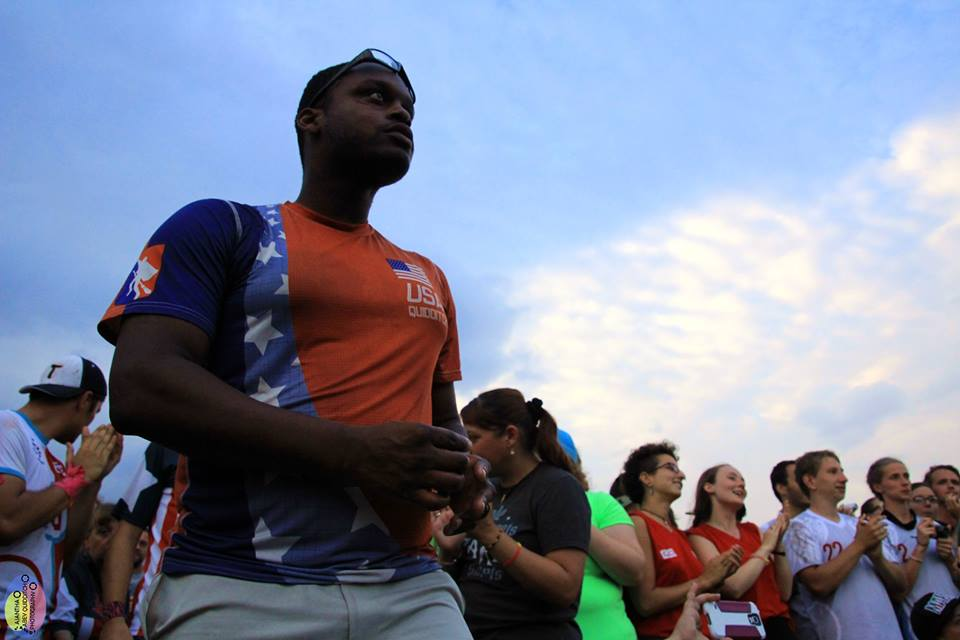
Team USA Head Coach James Hicks at the closing ceremonies for the 2016 Quidditch World Cup. | Photo Credit: Ajantha Abey Quidditch Photography
Before I get started, I would like to thank the Quidditch Post, and particularly the sections abroad. For the past year, I believe that your coverage of international teams and events has helped keep us updated on quidditch around the world, not just in America, and I’ve enjoyed following international quidditch because of it. I would also like to thank you for reaching out for a different kind of interview - for giving me a platform to share my personal experience and my feelings after a tough weekend for USA quidditch. Not many sporting media outlets do that after a tough loss, so it’s very much appreciated.
Wednesday, July 20, 2016
World Cup 2016: Spotlight on the United States
By Danielle Lehmann and Bruce Donnelly
History
History
The United States has the honor of saying that quidditch started here, at Middlebury College in Vermont (in the northeastern United States) by Xander Manshel and Alex Benepe in 2005. As freshmen that year, Manshel and Benepe created the groundwork for quidditch, but it was quite different from the sport we know today.
Thursday, July 14, 2016
World Cup 2016: Spotlight on Team USA Northwest Representative Stew Driflot
By Benji B’Shalom
In mid-March, USQ released the roster for Team USA. Players from across the country were chosen by an interregional committee to represent the United States, and these passionate athletes will travel to Frankfurt, Germany for the 2016 IQA World Cup this summer. Out of the 21 rostered players, only one hails from the Northwest Region. In July, the familiar stars of the 2012 and 2014 national teams will be joined by a tall, thin, blond newcomer.
In mid-March, USQ released the roster for Team USA. Players from across the country were chosen by an interregional committee to represent the United States, and these passionate athletes will travel to Frankfurt, Germany for the 2016 IQA World Cup this summer. Out of the 21 rostered players, only one hails from the Northwest Region. In July, the familiar stars of the 2012 and 2014 national teams will be joined by a tall, thin, blond newcomer.
Tuesday, June 7, 2016
Gender Rule Excludes Womens Colleges
By Taylor Veracka
What does quidditch have in common with horseback riding? For now, the sports’ only similarity is the fact that both allow all genders to compete with and against one another, though many hold out hope that quidditch will eventually join equestrianism in the Olympic Games. Gender inclusivity is something that not only sets quidditch apart from most other sports but also presents many unique challenges, specifically in governing the politics of a full-contact sport where all genders can participate.
What does quidditch have in common with horseback riding? For now, the sports’ only similarity is the fact that both allow all genders to compete with and against one another, though many hold out hope that quidditch will eventually join equestrianism in the Olympic Games. Gender inclusivity is something that not only sets quidditch apart from most other sports but also presents many unique challenges, specifically in governing the politics of a full-contact sport where all genders can participate.
Subscribe to:
Posts (Atom)